Thursday, May 14, 2015

Farewell, Margaret

I learned today that a dear friend of ours, Margaret, passed away yesterday.  Her death was a shock as she was still fairly young (in her 50's, which is still young these days), vibrant, active, and enjoying life.  As it turned out, she died from choking on some food.  Something that could happen to anybody, including you or me, at any time.  Margaret was alone at home and had nobody to help her out.

I met Margaret through art.  She worked in a style that resembled German Expressionism, only with a gentle, warmly humorous, and loving manner.  It was far more sophisticated than most people understood.  Margaret loved the people, places, and things in her life and showed it in her artworks.  We have one of her paintings of a horse.  This wasn't just any old horse, it was a particular one that had a funny way of looking at her that made her laugh.  So she painted a portrait of it.  In the same way, she painted the people in her rural area - country people that could easily have been the butt of jokes from somebody else, but whom Margaret treated with warmth and appreciation.

Horse
Margaret Katz Nodine
Oil on panel, 16"x20"

More importantly, Margaret was a wonderful person to be around.  She was outgoing and genuinely interested in other people.  She had a large circle of friends and delighted in them.  I never heard her say a bad word about anybody.  Anybody.  She took great pleasure in digging in her garden, despite allergies that should have knocked her down, and she absolutely loved her dogs.  Anytime we saw her, she was all laughter and stories and enjoying whatever she was doing.

And now she's gone.  Just like that.  One bite that went down the wrong way and a vibrant life is cut too short.  Unexpected deaths have a way of making you re-examine your priorities, don't they?  They make me realize that life is a gift and we should do our best to enjoy what we have.  It's so easy to get caught up in life's minutiae, or in the things that "have" to get done, and forget about the daily joys that we're presented with.  So this afternoon, I sat outside, watching the light shimmering off our birch tree, listening to the birds chirping their songs to each other, scratching my dog's ears, and feeling the light breeze flowing through the valley.  Appreciate what you have.

If Margaret was able to comment on her own death, I bet that she'd have something to say that was ironic, funny, and absolutely on-point.  Something like, "Some people get to go out like heroes, saving somebody from a burning house or whatever.  Me, I get done in by a sandwich.  Oy!"  And she'd have a huge laugh over it.

We miss you already, Margaret.  Sleep well, my friend.

PS - A late correction.  We learned later that Margaret died of a massive heart attack, not from choking as was originally thought.  Either way, we have lost a wonderful woman.

Sunday, May 03, 2015

Abandoning our Friends

Fuck you US embassy dick suckers
Fuck US States department
You guys are fucking playing games with our feeling son of bitches.
                                       - Najeeb Ahmadzi

That came from somebody who has earned the right to rant: one of the thousands of Afghans and Iraqis who put their lives on the line for the American efforts in their countries.  Men and women who served as interpreters, advisors, office staff, engineers, expediters, and the hundred and one other positions of trust that could only be done by locals.  These were people who believed in what we were doing, who supported our efforts, who often defied threats, family ostracism, extreme danger, and poor treatment, in order to do their jobs.  All they asked in return was that we hold up our end of the bargain.  Many of those bargains included the promise of special immigrant visas (SIV's), which allowed them to resettle in the United States when their service was over and their lives were in danger.  

Our country, unfortunately, is breaking its promises.

Ahmadzi is hardly alone.  There are literally thousands of Iraqis and Afghans who have had their SIV applications denied or indefinitely delayed for any multitude of reasons.  My own interpreter from Afghanistan has been trying for three years to get his promised SIV.  His application has been denied three times, with no explanation as to why.  He is somewhat fortunate, in that he has a support team made up of the Iraqi Refugee Assistance Project (IRAP, an organization working to help Iraqi and Afghans with their visas and other issues) as well as those of us who worked with him in Kandahar.  After a lot of investigating, and with no help at all from the US State Department, we eventually learned the reason.  And it's not something that will change easily.

A bit of context first.  I worked for the State Department in both Iraq and Afghanistan.  My experience was not very positive.  I found it to be an extremely bureaucratic organization whose culture was based on avoiding decisions and responsibility.  As a retired military guy, from a culture in which making decisions and taking responsibility were valued, I found this to be jarring.  Individual people in the State Department were often wonderful, but the culture of the organization as a whole was dangerous and disturbing.

When the SIV program was first proposed, our then-Ambassador to Afghanistan, Karl Eikenberry, was against it.  He thought it would drain Afghanistan of its best and brightest.  Unstated in his emails, but certainly an issue in the background, was the idea that helping Afghans leave the country would be the equivalent of admitting that our efforts at building the country had failed.  Despite his objections, Congress approved the program and ordered the State Department to implement it.

The State Department leaders handled it in the perfectly bureaucratic manner that they have mastered when told to do something they don’t want to do.  First, they had their lawyers review every word and punctuation mark that Congress had provided.  Then they drafted their own interpretations of what the laws said and devised a byzantine process to follow these interpretations.  Finally, they hired a non-US contractor to implement the program.  This allowed the State Department to create a process that was guaranteed to fail, while at the same time providing cover and deniability for those responsible.  And they were brilliantly successful.  In 2011, the State Department issued three SIV visas.  That's all: three.  In the course of the whole year.  In 2012, that rose to 63.  Public outcry resulted in pressure on Secretary of State John Kerry to review the process, and in 2014 they processed 3,441.  Still, there are over 6,000 applicants in various stages of the process in Afghanistan.  In Iraq, there are over 57,000.  

So here’s what the State Department’s application process entails:
1.  File an application online.  This includes the DS157 form, copy of a national ID card, copy of a passport, proof of employment (including both an employment verification letter from any contractors, badges used on bases, and so on), a letter of recommendation from a direct supervisor, and a statement of any dangers being faced.  If you’re missing any of those things, for instance if you don’t know how to get in touch with your former supervisor, you’re out of luck: no visa for you.
2.  If the first step is successful, the applicant has to file an application for a visa.  It requires much of the same information for the applicant and every member of the family.  The applicant also has to get a physical.  There is only one clinic in Afghanistan authorized to do the physicals, and they cost $500 for each individual, including the kids.  The physicals are only good for a period of time, so if the Embassy drags its heels on approval (which it usually does), then they have to get the physicals done again, at the same cost of $500 per person.  The visa process is completely separate from the SIV application process, and there are many cases of a person getting approved for an SIV and then having the actual visa denied based on the same information.
3.  If the applicant gets through the first two stages, he or she gets an interview at the U.S. Embassy.  This includes a polygraph test and a background investigation.  Ever taken a polygraph test?  There’s a reason that poly’s are not admissible in court: they’re error-prone.  They do not detect whether a person is lying, they just detect whether a person has an involuntary reaction to a question, and they have a very high number of false alarms.  If the interviewer doesn’t like your answers, or if you react on the poly, you’re out of luck.

At the same time, there are many hidden traps that the Embassy does not tell you about.  For example, the State Department’s original instructions said that the program applied to those people who had been employed “by, or on behalf of, the US Government”, for a period of at least 12 months.  My interpreter had spent 27 months working exclusively with US Special Forces, US Army units, and the State Department.  Sounds like a slam dunk, right?  No.  The State Department refused to recognize all but four of those months.  They never once explained why, despite repeated requests from both my interpreter, myself, and IRAP.  We eventually discovered that the company my interpreter worked with was paid on an ISAF contract.  Since that wasn’t a US contract, his time there didn’t count.  Despite minor changes to the program since then, his time there still doesn’t count.

Another trap is that the Embassy has set up a special, anonymous hotline, where people can phone in allegations against anybody working for the US, past or present.  That will derail an application.  The Taliban knows this and makes use of it.  So, in effect, the State Department has to have the Taliban’s approval before issuing an SIV.  If the Taliban wants the individual to stay in Afghanistan so they can be killed, they just have to call in an allegation and the State Department is happy to oblige.  

Another trap is that of any bureaucracy: slow-rolling the process.  This delays applications until the program expires, when they don’t have to worry about it anymore.  The State Department did this in Iraq, resulting (as noted above) in over 57,000 applications being stalled in the pipeline when the deadline passed.  That’s 57,000 decisions the State Department didn’t have to make.  Except, thanks to a lawsuit filed by IRAP on behalf of some of those Iraqis, the State Department was forced to re-open the pipeline.  But as we’ve seen, having the pipeline open, and actually getting people through it, are two very different things.

There have been many articles this month about the fall of Saigon 40 years ago.  Many focused on “Operation Frequent Wind”, in which over 7,000 people were evacuated in two days, and “Operation Babylift”, in which over 3,300 young children were evacuated in three weeks.  The differences between those two programs and the State Department  processes in Iraq and Afghanistan are immense.  The Vietnam operations were run by the military.  Under chaotic conditions, young soldiers, sailors, airmen, and Marines evacuated more people in three weeks than the State Department has processed in four years.  Unlike the State Department, they didn’t demand that application forms be filled out, proof of citizenship be provided, physicals taken, or polygraphs be passed.  No, they saw people in immediate danger and did their best to get them to safety.  

The State Department, though, couldn’t care less.    

But the Taliban does.  They have a pretty good idea of who worked for the US and they’re picking them off at the rate of about one every 36 hours.  My interpreter has been attacked twice.  The first time, they shot him off his motorcycle and left him for dead in Kandahar City.  The second time, they missed him, but blew his mother’s brains all over the back seat of his car.  His best friend, also an interpreter, was recently killed.  He and his family are now in hiding.  They have to move frequently and change phone numbers because the Taliban keep finding out where they are.  His family has disowned him because of the danger brought on them.  There are literally thousands of others in the exact same situation.

Lest you think that these are just the rants of one crazy old man, here are a few sample articles on the problem that have appeared recently.  Google “Afghan interpreters”, “Iraqi interpreters”, “interpreters killed”, or similar topics, or go to the Iraq Refugee Assistance Project and read more.


So what can you do?  Contact your Senators and Congressman and urge them to do two things.  First, hold hearings and force the State Department to own up to their abysmal performance.  Second, urge them to revise the language of the laws governing the program to make it easier to understand, more transparent, more responsive, and much, much faster.  Lives depend on it.

Until it’s fixed, thousands of people who were our friends and allies will be saying the same things that Ahmadzi said:

Fuck you US embassy dick suckers
Fuck US States department
You guys are fucking playing games with our feeling son of bitches.

Tuesday, April 21, 2015

Working on a Painting

I've been working on a new painting lately.  One of my favorite models has a clothing design business.  I thought it might be fun to do a painting of her creating an outfit.  She thought so, too, when I asked her, so we set a date for the studio.  She brought over a bunch of her own stuff, including a manikin and a sewing machine, and we set stuff up, moved it around, did a lot of sketching, tried a lot of poses, took a lot of photos, and gradually something started coming together.

Some artists like to create stuff as it comes out of their heads.  I don't.  I like to work with my subjects and get their ideas about what to include or leave out, how they should dress, and how they should pose.  My artworks are usually about specific people, so they have to tell me, and show me, what's important.  For me, it's very much a process of discovery.  They will constantly surprise me with things I'd never have thought of.  This even goes to life drawing sessions.  You'd think that there wouldn't be too many surprises when the subject is literally stripped down to bare skin, but not so.  I generally let my models find their own poses and have found that their personalities are always there in the pose.  Anytime I get too specific with direction, the result is always - always - blah.  I don't have to worry about that with this model - she's a firecracker, full of energy, and always coming up with something interesting.  Which is why I asked her to work with me on this project.  She came through in spades.

She showed up in a funky outfit of black and muted colors with a leather carpenter's toolbelt filled with sewing stuff, including a Sponge Bob pincushion.  She played around with some various bits of cloth I had lying around, and the next thing I knew, a raggedy old scarf was well on its way to becoming a classy evening gown.  She set up her antique sewing machine and had it looking like it was hard at work.  Sewing samples, sketches, and magazine ads went up on the wall behind her.  And in the middle of it all was this ball of fire who created a believable dressmaker's studio in an area the size of a closet.

After the session was over, we left everything set up.  I did some more drawings over the next few days and tried a lot of different combinations of poses, compositions, adding and subtracting stuff, until I had something to work with.  Then I refined it into one rather detailed drawing.  Today I transferred the drawing to a panel and began an oil study.  At each step, I'm learning what works, what doesn't, and getting a better understanding of how to put it all together.  This approach seems really slow, doesn't it?  Well, it is.  I'm following the advice of the painter Jerome Witkin, with whom I studied once, and who told me to draw and draw and draw before ever putting paint to canvas.  The reason is to work out as many basic issues as possible beforehand, so you have a good understanding of how the painting wants to come together.  Jumping into the painting too early is like doing a play without rehearsing.

So here's the drawing, as it sits right now, next to my easel:


Monday, April 06, 2015

A Particular Type of Mortality

Yesterday was Easter.  The Christian world was largely focused on the thought of rising from the dead.  My thoughts, though, were on it's polar opposite: the decision to deliberately end one's life.  No, not mine.  The 18-year-old son of a dear friend of ours made the decision last week to end his young life.  A great many of us are wondering why.  And trying to provide love and support to his mother.

I have not had much experience with suicide in my life, fortunately for me.  When I was about 20 years old, I carried the torch for a lovely and lively young lady.  She, however, carried a torch for some other guy who treated her like dirt.  Sometime before I met her, she had tried to commit suicide.  By the time we connected, she seemed to have recovered and was living a normal life.  "Seemed" is the important word here.  There were large areas in her life that were walled off from me and, I suspect, most other people.  So although we dated for quite some time, had a lot of fun, and were close, she kept a major part of herself locked away and hidden.  Eventually, she left town to be with the other guy, he treated her like dirt again, and she again tried to commit suicide.  I saw her a few times after that.  As before, she seemed to be normal, but the wall was still there.  I've often wondered how her life turned out, whether she made it past whatever demons drove her to attempt suicide twice, or whether the demons won.

Many years later, while I was the Executive Officer at a Navy command in Misawa, Japan, we had two suicide cases.  One was a young enlisted woman.  Her incident was clearly a cry for help rather than a serious attempt to end her life.  We arranged for psychological help for her, and engaged her supervisors, division officer, and friends in providing her with support, and generally tried to help her deal with her issues.  I'm afraid that we weren't very successful.  She had a couple of other, very different incidents later on that (fortunately) didn't involve suicide attempts, and we eventually had to give her a medical discharge.

The other individual who attempted suicide was very different.  The young man was hospitalized after his attempt.  The CO and I went to see him in the hospital and talked with the doctor, who told us that this was a very serious try and that, if not for somebody finding him in time, he would have died.  We then went in to talk with him and it was, in a word, chilling.  The young man was emotionally dead.  There was no interest, no spark, nothing.  I babbled some things about his shipmates pulling for him, and that we wanted him back at work, and it was like talking to a wall.  He wasn't unresponsive - he talked with us, answered our questions, but was pretty clear that there was no reason for him to live.  There was nothing about life that had any hold on him any more.  It really shook me up.  I had never had a conversation with a dead man before.  I'm not saying that to be funny: it really was like talking with somebody who was already dead.

And now my friend's son has ended his life.  It was, apparently, a complete shock, not only to his immediate family, but also to his friends.  He had a lot of friends.  It seems that none of them had any idea that he was considering ending it all.  But he did.  It's not a question of it being an accident, it was quite clearly a deliberate, well-thought-out act.

Suicides sometimes run in families, and that's the case here.  This young man's father committed suicide about 11 years ago.  Two uncles did as well.  Is it genetic?  Maybe one suicide leads others to consider it as a viable way to end their troubles?  I don't know.  Pain sometimes begets pain, in any number of ways.

Meanwhile, his family and friends are left with picking up the pieces of their lives and, eventually, continuing on.  Only there will be this huge hole where he used to be.  His mother has a large circle of very supportive friends who are doing everything they can to help her through this time.  I don't quite know what to say to her, but we're going to see her Thursday, so we'll try to do whatever is appropriate.  We don't have answers, just support.

Sunday, March 29, 2015

Artworks

I haven't made very many posts about my art lately, dammit.  The fact is, I haven't been making much art for the past few months.  My consulting business got really busy and there was too little time for the studio.  I'm trying to turn that around now, though, and have been in the studio more in the past week than in the whole previous month.  So here are a few recent paintings and drawings:

Underpass
Oil on panel, 16"x20"

This is my newest painting.  I wanted to do an urban landscape with an empty feeling.  This one seems to be successful.  I usually have to live with a painting for a while before understanding it, but it seems to hit the right notes for me.


 Amy F. #4
Graphite on paper, 12"x9"

I go to life drawing or life painting sessions when I can.  There's a session on Monday nights in Asheville with very short, 1-5 minute poses.  This sketch is from one of those sessions.  Short poses are a lot of fun because you have to work fast and you either get it or you don't.  This young lady was hanging onto a bar mounted on the wall, giving her a very dynamic flow to her body.


Evie May and Liam
Oil on canvas, 7"x9 1/2"

Some neighbors have these two great kids and we had a lot of fun with them over the past couple of years.  Unfortunately, they recently moved out of state.  Janis was missing the kids, so I did this oil sketch for her.


Kelly #1
Charcoal on toned paper, 16"x12"

This was from another of our life drawing sessions, one with the more usual 20-minute poses.  I'd been away from the sessions for a bit and didn't know how the drawings might turn out.  This one turned out okay but others from that night went right into the trash can.  That's just the way it goes sometimes.


Sunday, March 08, 2015

A Taste of Spring

After a wicked six weeks or so of winter, we finally had a beautiful spring-like day today.  It was bright and clear, with temperatures in the 60's.  Hallelujah!  So we decided to go ride our bikes at the Biltmore estate.  I pulled the bikes out of their winter storage in the garage, pumped up the tires, gave them a first-rate pre-flight check ("yep, they still have handlebars ..."), loaded them onto the bike rack, and off we went.

And joined about half the population of Asheville at the Biltmore.  Turns out that our bright idea was the same bright idea everybody else had.  The paths were full of bikers, hikers, strollers, dogs, kids, and every imaginable combination thereof.  So it was slow going.  But still, it was good to get out again.  We puttered along, really just getting the feel of the bikes, getting our legs adjusted to pedaling, trying to pick up where we left off last fall, and enjoying the day.  Everybody was in a good mood, too.  Don't you love it when everybody is smiling and happy just to be there?

The Biltmore is a pretty good place to ride bikes.  The trails are smooth and easy, both when they're paved, when they're gravel, and even when they're just dirt.  Since the biking/hiking trails are separate from the roads, you don't have to worry about cars running you down.  We stayed on the flat land.  There are some trails that go up into the hills, but this is our first ride of the year, so we avoided the steeper trails.  We'll try them later.

I saw lots of places that I'd like to come back to and paint.  It's much easier to spot them on a bike than from a car, since you're right there and going slow.  And when you find a place, you can just stop.  In a car, you have to find a place to park, and it may be a long way away.  One of the things I'm going to have to take a look at is how to carry my French easel and painting stuff on the bike.

So that was it.  A really nice day outside.  My legs are feeling the unfamiliar exercise already, which is a good thing (for now, anyway - I may be singing a different tune tomorrow morning).  Looks like we're going to have a wet week, but we'll have highs in the upper 50's, which is ABOUT FRICKIN' TIME!  

Sunday, March 01, 2015

American Sniper

We finally got to see American Sniper today.  I was really looking forward to it after hearing and reading so much about the movie.  Some things lived up to the hype but other things did not.  

First, the good.  Bradley Cooper is phenomenal.  Cooper is a bit of a pretty-boy with delicate features, but for this movie, he bulked up 40 pounds of pure muscle and became a beast of a man.  He learned to speak with a true Texas accent.  Most importantly, he brought depth to the role.  Even his silences, or the way he would throw a glance, told volumes.  He became Chris Kyle.  Cooper showed how Kyle got to be the way he was, he showed you the stress that being a sniper can put on a man, and he made you understand the difficulty that warriors can have in adjusting to normal, everyday civilian life again.  This was world-class work.

Sienna Miller did an excellent job Taya, his wife.  Her role in the movie was to bring out the stress in adjusting to civilian life.  I thought that Sienna did very well with what she had to work with.

Unfortunately, I thought the script didn’t do the story much justice.  Granted, this was a biopic that covered many years (with a focus on 11 years, from Sep 11 to the day he died), so it required a lot of things to be addressed.  But the result was a movie that was a mile wide and an inch deep.  Cooper brought a lot of depth to Chris, Sienna brought some depth to Taya, but everybody else was just a 2-dimensional figure, a stereotype of “SEAL officer”, “Iraqi woman”, “kid”,  “random friend”, and so on.  Chris would have an emotional reaction to people getting shot in combat, or saying something important at home, but as a viewer, I had no emotional connection to those other people at all.

There was a lot of hype about how everybody involved in the movie wanted to get the details right.  Bad news: they didn’t.  There were quite a few eye-rolling moments for me.  Even things as simple as driving a HumVee around a base were obviously Hollywood ideas of how HumVees move.  Helicopters don’t fly around bases in real life like they do in the movie.  Soldiers don’t do mission briefs that way.  Failures like that are distracting.

Finally, the script created an insurgent sniper as a foil to Chris.  In reality, there was no comparable sniper.  Yes, there were insurgent snipers and they killed a lot of good people, but the idea of a master sniper in conflict with Chris was a storytelling creation.  And, for me, it didn’t work.  The real conflicts provided enough combat drama for dozens of Iraq War movies.

I thought the movie really missed a golden opportunity in addressing the difficulties that warriors have in re-adjusting to civilian life.  They touched on it enough to show that Chris had a hard time.  Normal events like a van coming up behind him in California, or the rip of a pneumatic drill, or even a blank TV screen, could take Chris back to the battlefield.  And the viewer will understand why that is.  But they did it just enough to say “Chris had a hard time adjusting at home” and then quickly moved on.  I think that a whole movie could be built around this concept.  In fact, it should.  

We’ve seen three other war-related movies this year: Fury,The Imitation Game, and Korengal.  All were better films than American Sniper.  The first two stripped their story down to the important bits and let their characters develop to where I cared about them.  The real-world story of Chris Kyle, the real-world story of combat in Iraq and Afghanistan, and the real-world stories of veterans trying to adjust to peacetime American society, are more important stories than that of a fictitious tank crew or a genius fighting bureaucracy, but this movie didn't tell them very well.  Korengal is a documentary that explores the men who fought at a remote outpost in Afghanistan.  Not only is Korengal’s story equal in importance to American Sniper, but it makes you really understand the effect that war has on men.  Particularly the young men who bear the brunt of the fighting.  

So I was a bit disappointed in American Sniper.  It was a good movie, but not nearly as good as it could have been.  For me, the best war movie of the year was Korengal, then Fury, then The Imitation Game, and finally American Sniper.


But I really, really want to see a well-done film that explores the difficulty of readjusting to civilian life.

Wednesday, February 25, 2015

20 Feet from Stardom

The other night, we watched the movie "20 Feet from Stardom".  This is an Oscar-winning documentary film that focuses on background singers who stand, literally, 20 feet from the star of the show.  It features a few legendary singers like Darlene Love, Merry Clayton, the Waters family, and Lisa Fischer, as well as the emerging artist, Judith Hill.  It's a powerful discussion of the music industry, artists clawing their way to the top, and what their definition of "the top" is.  I recommend the New York Times review for an in-depth discussion of the film.

Although the focus is on singers, the discussion is really about finding success.  And in this way, it is directly applicable to theater, visual art, and many other fields of endeavor.  It presents us with several women with phenomenal voices.  They live to sing, and the things they can do with their voices will bring tears to your eyes: the power, spirit, joy, and pain are unbelievably rich, sometimes raw, sometimes both.  They are incredibly powerful artists who can sing better than many (most?) big-name stars.  Yet none of them became a music star in her own right.

So you have to wonder, why is that?  How can somebody who can sing like that not be a star?  Part of it, I think, is the music industry, part is our culture, part is luck, and a big part is the individual artist's personal character.  And there's another question: does success always require being a star?  Or is there another way to define success?  Let me ramble on those thoughts for a few moments.

It's well-known that the music industry is cut-throat.  There was a bit of discussion in the film about Phil Spector's handling of Darlene Love and others back in the '60's, in which Darlene and others recorded songs that were then released under other groups' names.  Actions like this weren't uncommon and were cold marketing decisions.  Unstated in the film, but certainly true then and now, is that we expect our star singers to be really good-looking.  A singer may have a phenomenal voice, but if he or she is a bit pudgy or plain-looking, they don't get the attention.  (Adele is the current exception that proves the rule).  The music industry makes decisions on artists that will be promoted, get the press, get on late-night TV, and so on, based on what their money-making potential is perceived to be, and singing is only part of it.  I used the impersonal term "the music industry" deliberately, because it is an impersonal process.  Yes, there are people in it who are passionate about particular artists, but the the process as a whole is impersonal.

And it's not unique to music.  Think about baseball, for instance.  Every baseball player wants to get to the major leagues.  Few do.  For every major-league short stop, there are dozens in the minor leagues, and hundreds of good college players who didn't make the transition.  Why?  Well, some of the things discussed in this movie are the same things happening in baseball, just described with different words.

I mentioned culture earlier.  We live in a culture that is constantly bombarding us with things demanding our attention.  We can't possibly listen to every musician out there.  So we ignore most of them and listen to those we know we like.  Your iPod will probably show you that you listen to the same few artists, songs, and albums a lot more than you listen to most of the stuff that's on there.  So even though Darlene Love and the rest have pipes that can blow you out of your car, you're not going to listen to them if you don't know their names.

A comparison might be restaurants.  Say you're rolling down the interstate and getting hungry.  You get off at the next exit and there are two places to eat: one named Joe's and the other a McDonald's.  Which one will you go to?  You go to the one you know.

Another part of making it to the "star" level is luck.  Pure and simple: being in the right place at the right time, with the right sound, and being heard by the right person, is critical.  All the big stars, if they're honest, will tell you that.  And most of them are a bit nervous, because they know that there are lots of people out there with equal or better talent that have not been discovered yet, and they could be dethroned by the Next Big Thing.

But the major factor in whether an artist makes it to the top is the individual artist's character.  Talent and ability is the foundation, of course: if you don't have the pipes, you're not going to be a singer.  Having the will and the drive is the difference between the club singer and the star.  In the film, more than one person mentioned the "killer instinct" - that ability to go for the jugular when necessary, and putting the goal of being a star singer above all other goals.  But being the star means making lots of tradeoffs.  I've seen that first-hand in other career fields when people put their career first.  Families and relationships often pay the price.

One of the things that made "20 Feet to Stardom" so powerful was the exploration of what being a success was all about.  Most of the singers wanted the spotlight for themselves and thought of backup singing as second-tier.  One singer, though, thinks differently.  Lisa Fischer has a voice so powerful that she tours with the Rolling Stones to sing "Gimme Shelter".  She has a world-class voice.  Yet Lisa isn't interested in pursuing the solo dream.  She loves singing for itself, she loves singing with others, and loves building something beautiful on stage.  Other singers in the film said that Lisa doesn't have the killer instinct.  And Lisa will agree with that.  She found a niche that she loves.  She found her own definition of success and, with that, found her own happiness.  Lisa's not chasing a dream that somebody else defined for her.

And this translates directly to my own experience with art.  I've got a pretty good set of artistic pipes with my ability to paint and draw.  I've got things that I want (need) to say with those skills.  I tried pursuing the "successful artist" standard - which is generally defined as selling your work through lots of galleries, making lots of money doing it, and so on.  Turned out it wasn't for me.  The things I wanted to paint didn't sell, and the things that sold, I didn't want to paint.  I was like a folk singer being told that I had to record pop songs if I wanted to be a "success".  So, like Lisa, I redefined what success meant to me.  I'm never going to have a retrospective exhibit at the Met and none of my works will ever sell at a Sotheby's auction.  I'll be the painter's equivalent of a backup singer.  And I'm really cool with that.  

Sunday, February 08, 2015

Creativity in Different Forms

Shortly after my last post, back at the end of December, my consulting business had a major project come in.  It wound up requiring a 7-day-a-week effort that is just now coming to completion.  I wasn't able to even go to the studio for a month.  One day, when I was a bit frustrated over the lack of time for making art, I saw a Facebook post from a friend that helped put it in perspective.  It was a quote from an anonymous source:

"I think everything in life is art.  What you do.  How you dress.  The way you love someone, and how you talk.  Your smile and your personality.  What you believe in, and all your dreams.  The way you drink your tea.  How you decorate your home.  Your grocery list.  The food you make.  How your writing looks.  And the way you feel.  Life is art."

Things have a way of slapping you in the face when you're ready for them, and I was ready for this bit of wisdom at that particular moment.  I realized that all my work on this project was, in fact, art.  And more than that, it was going to directly affect the lives of a great many people over the next five years, and many more indirectly for many more years in the future.

Okay, to back up a little and set the stage.  In my consulting work, I'm helping a couple of client companies put together contract proposals.  This particular proposal was in response to a call by a US government agency for companies who could provide specific services in developing nations around the world over the next five years.  One of my client companies is pretty well-positioned to do much of what was needed.  We brought in two other companies to fill in the capabilities that they lacked.  I wound up driving the effort to put the proposal together.

This was no small task.  The proposal had very specific requirements for what had to be addressed, which forms had to be filled out, what typeface and font size had to be used, the maximum number of pages, and so on.  Some of the requirements were contradictory: one form could not be filled out using the typeface and font size specified, for example.  And, since we were working with two other companies, I had to take their inputs and edit them into the required format and structure.

So how is this art?  Well, when I'm working in the studio on a "serious" painting, I've got something specific in mind regarding what I want the artwork to say.  Everything is crafted around that goal: the composition, things depicted, their relationships to each other, the play of light and dark, color choices, and on and on.  Everything is constantly being compared to everything else and tweaked to make the whole painting sing one harmonious song.  I'm not an impulsive painter, never have been, and cannot work that way, although I have great admiration for artists who can do it well.  I'm a linear thinker in the first place, and that trait was honed over 20 years in the Navy.

My proposal writing uses the same approach.  I had something very specific in mind, along with some given limitations of what I could and couldn't do.  Everything was crafted around the story that our team could do a fantastic job with any tasks that the government agency might need.  I built an outline (like building the composition in a painting), started filling in the major areas, added details, deleted less-valuable stuff to give more emphasis to more-important stuff, and in general made it as strong as I possibly could.  Then I sent it off to the client and partners for review.  When I'm creating a painting, I'll often ask a few people (my wife, for one) for their thoughts on the work-in-progress as I want to see if it says what I want it to.  In this case, it was very important that the experts in the client company and the two partners ensure that the proposal was (a) accurate and (b) compelling.  Then it went through revision after revision.  Again, this is something I do in a painting - there are many works where every square inch has been repainted multiple times.

So now we're down to the final few changes.  When it gets down to very minor wordsmithing, you know it's done.  And this one is very strong.  I'm extremely confident that we're going to get it.

I came to the realization a number of years ago that my goal in life is not necessarily to make a lot of paintings, but to create things that make a positive change in the world.  If I can do that through paint, wonderful, but it's not the only way.  This proposal we're finishing up will make a huge difference to the people who will actually do the work.  They're going to get the opportunities to work in places they've never worked before, and they'll be helping people who really need their services.  Even after the contract is over, the results of those services will be making a positive impact.  And this wouldn't happen if I did a crappy job with that proposal.

So I'm happy with the results of my work for the past month.  It was creative and it will have an impact.  But now I want to spend some make-up time in the studio!

Tuesday, December 30, 2014

Last Painting of the Year

Abdul Mahmood
Oil on linen panel, 16"x12"

Here's my last painting of 2014.  Obviously, it's not done from life - I based it on one of my "Faces of Afghanistan" drawings fleshed out with stuff pulled from a raggedy photo.  It captures the feeling of a real farmer that I knew in Afghanistan.

I did this as an experiment.  A few days ago, I saw some really powerful portraits from another artist.  I noticed some techniques he used that made the paintings so effective and wanted to try them out.  That artist was also a caricaturist.  As I've said before, doing caricatures is a great way to learn how to do portraits, because you zero in on the things that make each individual unique.  Caricatures greatly exaggerate those features, of course, but if the features are only slightly exaggerated, the result could be a really good portrait.

This farmer has a very narrow face in real life.  I played up the narrowness a little bit, and lengthened it just a smidge, and the result turned out pretty well.  I also paid a lot of attention to the colors, planes, and folds of his face.  These details seem to obscure the fact that the structure of the face is slightly exaggerated.

There were some other techniques that the other artist used that I tried to do, but couldn't.  They worked very well for him, but just felt wrong to me.  I've had that experience many times.  Copying another artist's work, or imitating his style, is a great way to add new tools to your painting toolkit.  But if the tool doesn't work for you, don't use it.

I hope you have a great New Year's!

Wednesday, December 17, 2014

Landscapes

As mentioned in one of my previous posts, I've been doing a lot of small landscape paintings lately.  They're quite different from my usual narrative figurative paintings.  Those are usually developed over a period of several weeks, with lots of thought given to what's depicted, how it's depicted, and what's left out.  Things may get repainted several times.  I've been known to repaint everything in order to change the direction of the light.  Little or nothing is spontaneous.  I probably over-think them.

These small landscapes, though, are very different.  I started doing them because they were something that worked well with my schedule.  I could jump in, do a painting in the time available, and drop it when my time wasn't available any more.  I've found that this approach has its own demands, charms, and rewards, and I'm getting a kick out of it for its own sake.

These small landscapes are much more about the activity of painting.  When you don't have much time, you go for the important things and try to get them as right as possible as fast as possible.  They're kinda like gesture drawings: you're going for the essence, not the details.  The result is generally a liveliness that isn't in my larger paintings.

Late Afternoon Rest
Oil on paper, 7.5"x10.5"

This one shows something of what I'm talking about.  I did a quick pencil sketch to understand the values and composition, then went to work on gessoed paper that had been toned with a slightly warm brownish-gray tone.  You can see it along the bottom of the image.  There were actually two cows in the field, but in the spirit of keeping things simple, I just painted one.  The head and neck were blocked in first with burnt umber, then the shadow of the body.  Then I slammed in the green hill behind the cow, keeping it light to make the cow stand out, and throwing in a lot of cad yellow to show the late afternoon light hitting the field.  The tree line is largely just vigorous strokes of different dark greens and umbers.

Autumn Blossom
Oil on panel, 12"x9"

Here's another example.  This pink weed caught my eye.  It was the only spot of strong color in a bunch of dead weeds.  Basically, I laid in a bunch of vertical, light yellow ochre to provide a background for the dark stem, and laid in a dark muted green to provide a background for the pink blossom.  I wasn't sure how to do that blossom, but in playing around with it, I did a quick stroke and it worked.  So I did a bunch more, touched it up with a few darker reds around the center and bottom, and there it was.

So what's the point of these landscapes?  Well, what's the point of figure sketches?  It's all about seeing, and about getting the hand and eye to work together, and at the same time trying to get the essence of the thing captured in paint.  I've learned a lot about paint handling and decision-making from these little works.  And had a helluva lot of fun.

Wednesday, November 26, 2014

Thanksgiving Eve

It's Thanksgiving evening.  We're at home, safe and warm, with our dogs for company and things to do.  Janis has been wrapping Christmas presents.  I did some work for one of my clients, ran some errands, and got frustrated with the company that hosts my web site.  It was a pretty quiet and routine day.

This evening, I watched the documentary movie "Korengal".  It's a follow-up to the movie "Restrepo", about a platoon of soldiers in the Korengal valley in Afghanistan.  Where "Restrepo" showed what life was like on a mountaintop outpost under constant attack, "Korengal" delves much deeper into the soldiers' minds.  It is a timeless film.  The way combat affects an American soldier or Marine now is not really different from the way combat affected them in wars past.  There is the adrenaline, the excitement of combat, the bonding among those whose survival depends on each other, the earth-shattering grief of losing a brother, the horror of some of the things that have to be done, and the almost wistfulness of veterans who miss the intensity of the experience once it's over.  "Korengal", far more than any other war movie I've ever seen, brings an understanding of the experience of combat, and an understanding of those who live through it.

It may seem to be an odd choice of a movie right before the Thanksgiving holiday.  Actually, it's the reverse.  "Korengal" brings a fresh appreciation for the quiet, normal life we have.  Janis and I are able to wrap Christmas presents, do some work for clients, get in the car and drive around to do minor errands, pound on a computer, and eat Thanksgiving turkey until we burst, because of men like these soldiers in Korengal.  They are the same as those warriors of all services who were in the jungles of Viet Nam, in the snows of Korea, on the beach at Normandy, in Belleau Wood, and all previous wars.  And they're just like the ones who are out there right now.

So this Thanksgiving, I'm giving thanks to them.

Monday, November 24, 2014

Exhibition in Ohio

As mentioned in a previous post, my "Faces of Afghanistan" drawings were shown at two branches of Ohio University.  I took the drawings up to OU Zanesville in mid-October, installed them, and gave an artist talk.  The exhibition was up for almost three weeks.  The curator then took the drawings down and installed them at OU Eastern.  The drawings were there for another three weeks.  I went up last week, gave an artist presentation, and talked to a lot of people at the closing reception afterward.  The next morning, I took the drawings down, loaded 'em into the truck, and drove home.


It's always great to get my work out of the studio and up on somebody else's wall.  Getting this series of drawings into colleges and universities is really good.  The drawings provide an insight into a world far different than the one the college students are living in.  I've had some interesting discussions with people as a result.  It seems like the initial questions are pretty basic, but quickly move into more complex territory.  Very stimulating.

I don't have any other exhibitions scheduled right now.  There are a few proposals out and I'm working on one or two more, so I'm optimistic that something interesting will pop up over the next few months.

Friday, November 07, 2014

Different Figure Drawing Styles

Since my last post, I've been to a number of life drawing sessions and, in between, have been painting the fall colors.  These are two very different subjects that can't be tackled in the same post.  So I'll talk about figure drawings today and talk about fall landscapes next time.

The Asheville area is fortunate to have a lot of life drawing sessions going on every week.  On Monday evenings, David Lawter has a two-hour session that is entirely short poses.  He starts with 1-minutes and ends with a 5-minute.  That's quick.  Because of that, it's lots of fun: you have to have to keep moving because the next pose isn't going to wait.  My drawings usually have a lot of life to them because of that.  On Wednesday evenings, Frank Lombardo runs a 3-hour, single-pose session in Marshall.  This is the polar opposite of David's session and is great for painting.  On Thursday evenings, David has a two-hour session that is mostly 20-minute poses - great for drawings that have some development to them.  Yes, that means David runs two sessions a week.  The guy is dedicated.  If you're interested in either Frank's or David's sessions, contact me and I'll put you in touch with them.

I'm constantly trying to improve my skills, so going back and forth between the different sessions is good.  It doesn't let me get into a rut.  I'm also constantly looking at other artists and seeing what I can learn from them.  One I'm looking at pretty hard now is Steve Huston.  Steve lives/works out west and is associated with the New Masters Academy in Huntington Beach, in the Los Angeles area.   I took an online workshop with him early this year (here's the post).  He's done a number of videos about his technique, some of which are on YouTube and others on the New Masters website.  I watched a video and decided to try out some of the ideas at the 3-hour life drawing session.  Here's what resulted:


This didn't come out at all like I intended and looks nothing like a Huston drawing.  However, it was an interesting exercise.  I did a rough line block-in of the figure in vine charcoal on a pale toned paper, then smudged charcoal all over the place,  Then, in addition to laying in the darks with more charcoal, I drew just as much with the kneaded eraser to pull out the lights.  The result has a lot of heft and volume.  It's more like a traditional style of drawing, I think - slow and deliberate.  Yes, it's probably overworked, and some parts need more development (which they've gotten since this photo was taken).  Still, I got to try some new ways of working, and added some new tools to my drawing tool chest.

After this, I went back to Huston's work to figure out where we were different.  I saw that Huston is very concerned with the form, and builds it up with fluid, flowing, gestural lines (like what I do with the very short poses).  He then focuses on three lines: the two outside edges of the figure, and the intermediate shadow in between.  The "intermediate shadow" is the one at the boundary between the lighted and shadowed area.  Getting this one right is really critical to getting the feel for volume in the figure.  You have to pay close attention to where it is wide and narrow, where it has soft edges and sharp, and how light or dark it is.  Huston also works with a small range of light values and a small range of darks, not a full spectrum of values like I did in the drawing above.

So I went to a session with shorter, 20-minute poses, and here's one of the results:


This one started with more gestural strokes and then was gradually developed using both the vine charcoal and kneaded eraser.  I tried to keep both tools working quickly and not get bogged down in detail.  I also tried to limit the values to a small range of lights and a small range of darks.  Most importantly, I paid close attention to the outside lines of the form as well as the intermediate shadows.  You'll see that some of the outside lines are pretty heavy.  A heavy, dark line accentuates the light volume of the form next to it.  Mostly, though, it's the intermediate shadows that define the volumes of the form.  Follow the intermediate shadows down from the shoulders, through the hips, and down the legs, and you'll see how their movement back and forth shows how she's standing and twisting.

Finally, here's a detail from a sheet of figure drawings from Monday's short-pose session.  I used the same principles here as in the drawing above.  Quick gestural lines establish the figure, while hatched areas indicate the shadowed areas and create the figure's volume.  This was done with a mechanical pencil on a Strathmore sketchbook.


This is actually a pretty similar approach to the one I talked about in a post last month, in which I used a Sharpie pen during the 20-minute poses.  As a refresher, here's one of those drawings:


This is quick and gestural, but it doesn't have the same focus on the intermediate shadow.  It's still a pretty decent drawing.  Different tools and different approaches are needed for different drawings.  I feel like I've expanded my capabilities a bit over the past month or so.  Cool stuff.

By the way (crass commercialism alert), several of these drawings are available on my Etsy gallery at ridiculously reasonable prices.  Just sayin'.


Thursday, October 16, 2014

"Faces of Afghanistan" at Ohio University Zanesville

I just got back from a road trip.  Ohio University Zanesville offered to exhibit my "Faces of Afghanistan" drawings.  So I drove 'em up, installed them, gave an artist talk, and got back yesterday.

Except it wasn't quite that simple.

I was thrilled to have the opportunity to show the drawings up in Ohio and jumped at the chance.  Zanesville, though, is 435 miles from here.  So rather than get up at 0-dark-thirty and have all the pressure of a deadline to meet, I split the trip into two days.  That allowed me to take highways instead of the interstate, something I much prefer doing whenever possible.  Weather kinda/sorta cooperated and it was a beautiful trip through the mountains of Tennessee, Virginia, and West Virginia.  I stayed overnight in Marietta, Ohio, and finished the drive Monday morning, again on the highways.

OU Zanesville is a nice campus with great people.  We had some issues with the hanging system, in that it wasn't geared for as many artworks as I brought, but everybody had a "we'll make this work" attitude and we got it done.  I had barely enough time to do a quick change of clothes before we started the artist talk.  It went really well, too - lots of interaction with the audience and lots of good questions.  I really enjoy those events.  Afterward, there was a reception and more talk for an hour and a half.  Had a really good discussion with a Desert Storm vet who is still carrying some pretty deep physical and mental scars over 23 years later.

I planned to come home the next morning, Tuesday, but a monster storm was set to pound the whole route, so I decided to stay put in Zanesville.  The weather there wasn't bad at all, just a bit cloudy, and Ohio was in the peak of leaf season, so I grabbed my camera and went exploring.  Had a great time and got some beautiful photos.

Wednesday was travel day.  I hit the road about 9 am and did the interstates all the way back.  And it turned into a beautiful drive.  The clouds gradually cleared, there was some blue sky, and it was peak leaf season almost all the way down.  Phenomenal!  I got home just before 5 pm, right when Janis was taking the dogs out for their evening walk.  Trips are great, but it's always good to get home.

The good folks at Ohio University are going to take this show down in three weeks and move it over to Ohio University Eastern.  It'll be on exhibit there for another three weeks.  Then I'll go up, do an artist talk in the evening, and then take down the show and drive home the next day.  Neither drive will be as nice as this one was.  It'll be later in November and all the color in the trees will be gone.  Oh, well, the things you gotta do to get your art exhibited!

I really want to give high marks to the professors and staff at Ohio University Zanesville.  They really went above and beyond to get this show up.  It's always a pleasure to work with people like that.

Friday, October 03, 2014

Life Drawing Again

Now that we're back from our St. Augustine vacation, I was able to go to a life drawing session last night.  I wound up drawing the figure with a Sharpie pen and had some interesting discussions about the process with the other artists.

Claire #8

I decided to use pen and ink in a deliberate effort to force myself to loosen up.  That sounds counter-intuitive, doesn't it?  It's not.  A Sharpie is a harsh instrument to draw with.  Everything is either very black or very white, with sharp edges and little variation in line width.  It looks very mechanical, even industrial.  And it seems to demand that you get it right the first time, since it can't be corrected.  The human figure is the opposite, particularly when the figure is a female: it's soft and rounded, with infinite variation in color, shade, shadows, and shapes.

My approach is to let the pen fly.  One line rarely defines a shape.  Maybe, occasionally, one line will suffice along an edge, but usually, it's multiple lines that suggest the shape curving away.  Shadows can be suggested by hatching and cross-hatching.  The closer they are, the darker the shadow.  In the detail below, check out the shadows of her ribs compared to those under her arm.


Pen and ink initially makes you think that you have to get it right, which tightens artists up so much that they're afraid to make a mark.  I go in the opposite direction: it is not, and never will be, "right".  The model didn't really have a series of hash marks across her chest.  Those are just marks of something that is not really there.  But when those marks are combined with the white spaces of the paper in between, then the viewer's eye reads it as a light shadow.  So something that's "wrong" actually reads like it's "right".

For me, this approach works best when I work fast.  That keeps me from obsessing over details and adds a vitality and energy to the drawing.  Your eye picks up on the details, even if your conscious brain doesn't.  Notice the shadow marks in the ribs: you'll see the hook marks as one line ends and the pen moves over to the next line, or you'll see the rapid back-and-forth without lifting.  Some lines will just be wrong no matter what.  There's a couple of vertical lines in the shoulder that I put in during the initial blocking.  It would've been better if they were angled lines, like the ones I put in later, but they weren't.  No matter.  Stuff happens when you work fast.

When I'm drawing with a Sharpie, even more so than when I'm drawing with a pencil, my hand tends to dance over the paper.  That's the best description I can think of.  Keep the pen moving, bouncing from one thing to the next.  Keep your eyes on the subject.  Look at the shape of the form, the shape of the shadows, and let your hand (and pen) follow your eyes.  Don't try to make your drawing match the subject because it won't.

Another metaphor just popped into my head.  If you've ever been snow skiing, you know the difference between slowly and laboriously creeping down a slope, and flying down a slope with your skis and poles barely in contact with the snow.  One is painful to do and watch, the other is a glorious rush.  That's the same thing with drawing.  Obsess over every individual detail and you'll miss the excitement.

Tuesday, September 30, 2014

St. Augustine Beach

We just got back from a week in a beach cottage near St. Augustine, Florida.  It's something we've talked about doing for years.  We finally got tired of talking and just did it.  Janis went on VRBO.com (Vacation Rentals By Owner) and found a lovely 3-bedroom cottage a block off the beach, in a neighborhood called Butler Beach, which is a bit south of St. Augustine on Anastasia Island.  It was a wonderful place: quiet, peaceful, very wide beaches, and very few people.  Our next door neighbors joined us for a few days and we celebrated three birthdays and an anniversary while finding some really great (and some not so great) restaurants.  The weather wasn't so great as it rained almost every day.  On the other hand, the rain kept it cool (and MUGGY), and the rain rarely lasted very long, so it didn't really stop us from doing anything.  And Janis and I got to visit with a couple that we last saw 18 years ago.  Fabulous time!

I took my easel and painting stuff down.  My intent was to paint every day, but between the weather and Required Social Engagements, it didn't happen.  I did get four paintings done, though.  All are oil on 9"x12" linen panels.

Beach 1

This was at our beach access.

 Beach 2

Same spot, only turned around looking the other way.


Rain over the Matanzas River

I went over to the river side of the island one day, under some pretty threatening clouds, and painted this little study.

Palm and Phone Pole

Finally, a bit of clear(er) weather gave me a chance to play with some brighter colors!

These aren't earth-shattering paintings, but they were lots of fun to do, and I was happy to see that my landscapes are gradually getting better.  The compositions are stronger, I'm seeing colors better, I'm mixing colors better, and I'm painting better.  Progress is a good thing, no?

Sunday, September 21, 2014

Yard Art

Not every creative thing I do is related to drawing or painting.  Sometimes it's as simple as stacking stones.  The term "art" might be a stretch for this project, but it seemed to occupy the same creative space as my studio activities, so I'm gonna call it "art".

There's a spot by the bottom of our driveway that was difficult to deal with.  It was too steep to mow, too rock-hard to plant anything, and had roots from a dogwood tree that was just barely staying alive.  So 14 years ago, we got a bunch of river rock and I stacked them against the hill.  It protected the dogwood's roots and looked nicer than anything else we could think of.  Over the years, though, the carefully-stacked rocks settled and moved, the UPS and FedEx trucks ran over them, and gradually they went from being stacked to just being a pile.  Here's how they looked.


Finally, in August, I decided it was time to dismantle the stack and do it over while the weather was still decent.  I sorted them into four piles: small, medium, large, and flat.


The next step was to start laying them down in a way that would be stronger and (hopefully) more long-lasting.  I built up the strip along the driveway that was basically a drainage run first.  The trick was to select and lay the rocks, then fill the spaces between them with pea gravel, and then fill the remaining space with sand.  This locks them in place and minimizes how much they move.  I think.  I hope.


It took a heckuva lot longer than I thought.  I started about the middle of August during a cool spell, thinking it would take maybe a week.  Hah!  It took a week just to remove the rocks!  I found that I was good for maybe two or three hours at a stretch, starting in mid-morning and stopping when it got hot and this old body began to complain too much.  Finally about mid-September, the project was completed.  Here's how it looks now:


So why do I consider it "yard art"?  The process of making it.  River rock is all different sizes and shapes.  They're round like baseballs, oblong like footballs, shaped like cubes or discs, angled, twisted, smooth, rough, gray, brown, yellow, red, you name it.  You don't just pick one up and slam it down like you do with bricks.  You have to find the right rock.  I would stand there and look at the spot to be filled, getting a good visual feeling for the shape of the rock needed, then I'd go to the appropriate pile and find two or three.  Then I'd try them all, test fitting them this way and that, until it seemed right.  It wasn't really a conscious process, it was more like zen.  When I was in the groove, the selections and fittings flowed smoothly; if I wasn't in the groove, I couldn't find the right rock to save my soul.  And since each rock was different, I made use of that.  There were large rocks next to small ones, flat next to cubes next to rounds, gray next to brown.  It felt a lot like painting.  Except, of course, the rocks were a helluva lot heavier than any brush I've ever picked up.


But it's done.  And since I used some lessons learned from the last time I did this, 14 years ago, I hope it'll stay put longer.  I'll be a really old fart in another 14 years and don't want to do this again!

Thursday, September 11, 2014

Development of a Painting

As I've noted here before, I've been trying to develop some skills in landscape painting.  It's a subject that I have never done very well.  But it seems to be coming together now.  I've been fairly happy with what's popped off my easel lately.  What's more interesting is that it's a very different way of working than what I normally do.  It forces me to think more about composition, color, finding the focal point, and subordinating some things so that the important thing(s) catch your eye.  I usually think of the things in the painting as objects rather than as arrangements of paint, and the message in the artwork depends on the objects I paint rather than the way they're put together on the canvas.  So this has been a very eye-opening experience.

I thought I'd share the development of a recent landscape painting.  By the Cornfield is a small 16x12 oil on panel.  The setting is here in Madison County, NC, maybe a mile as the crow flies from my home.  Of course, this being Madison County, you have to drive maybe five miles to get there.


Here's the initial block-in.  It's in ultramarine blue mixed with burnt sienna.  I was attracted to both the tree and the road, and wanted to see how much depth I could get in the final painting.


Here's the first round of color.  I wanted to get paint over the whole panel so I could start adjusting it.  This first round of color, as it turned out, was too strong: all the greens really jumped, even in places where I didn't want them to.


At this point, I had learned that, for whatever reason, it was the road that interested me most, and I'd spent a lot of time on it.  I put some shadows on the road under the tree and in the foreground.  The ridge beyond the tree had been developed a bit, but I decided at this point that it was too dark and too green.  To push it back, away from the tree, I needed to lighten it and make it cooler (bluer) for atmospheric perspective.  The tree was pretty flat with little variation in lights and darks, so it needed to have some lighter lights and darker darks.  And the foliage in the foreground needed a wider range of greens as they were all pretty much the same.


Here's the final painting.  Making the ridge bluer and lighter really helped separate it from the tree.  I scumbled in a warm haze above the horizon line (yellow ochre and white).  The tree has a wider range of lights and darks, making it feel more three-dimensional.  I simplified the foliage to the left - originally there was a bush, but I couldn't get it to feel like a bush without taking over as the primary point of interest, so I simplified it.  I worked some warm "dirt" colors (yellow ochre, terra rosa, and white) into the ground on either side of the road and in the cornfield.  


And here for comparison purposes, is the original scene.  You can see the liberties that I took with it.  The tree, for example, blends right in with the ridge as there isn't a lot of distance between them, and it's confusing: what's the tree and what's the ridge?  The greens everywhere are really strong, too.  Maybe I could have kept the foreground greens strong, but I toned them down to focus on the road.  Here, though, you can see that it's the contrast between the green foliage that red/tan dirt road that makes it stand out.  

But there it is - the development of one of my new landscapes.  Your thoughts?

Sunday, September 07, 2014

The Disney Treatment

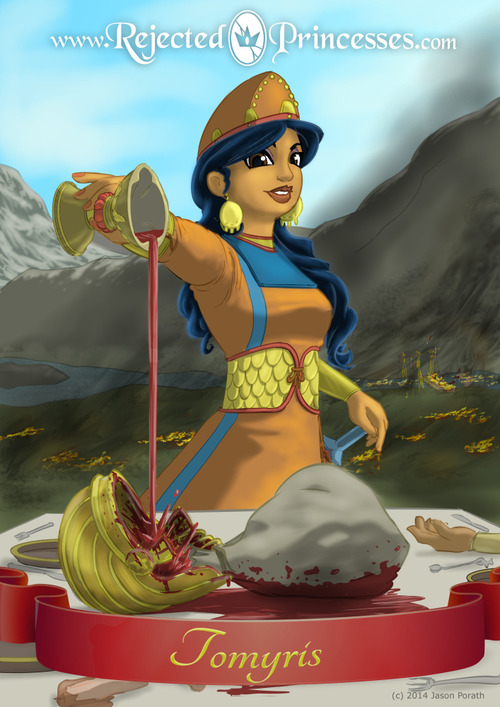
An NPR segment introduced me to a really cool art project.  Rejected Princesses puts a Disney spin on real-life women who were heroines or villains.  Jason Porath was a Disney animator.  One day, he and his buddies were sitting around, talking about how Disney would portray women that were too brave, capable, deadly, or otherwise too awesome for the typical princess role.  Disney, of course, isn't doing any stories on women who were Russian tank commanders, leaders of ancient fighting forces, or British spies.  So now Jason is doing it.


This attractive young lady, Tomyris, for example, was a widow in what is now Kazakhstan.  When the leader of the world's largest empire tried to marry her to expand his empire, she spurned his advances.  When he tried to take over by invading, she mustered up an army, kicked his ass, cut off his head, and publicly defiled it so badly that her name was a household word for centuries.  Not exactly Disney's idea of a pretty young thing who needs a prince to take care of her.

These images are well-researched.  Tomyris' outfit is authentic, as is the helmet of the defeated, decapitated, and defiled emperor, and so is the landscape.  Jason really knows how to tell a story with his images, something that I can really appreciate but cannot do nearly as well as he does.

Jason posts a new story every week.  I'm still digging through all the cool ones that he's already done.  Go take a look and check it often!